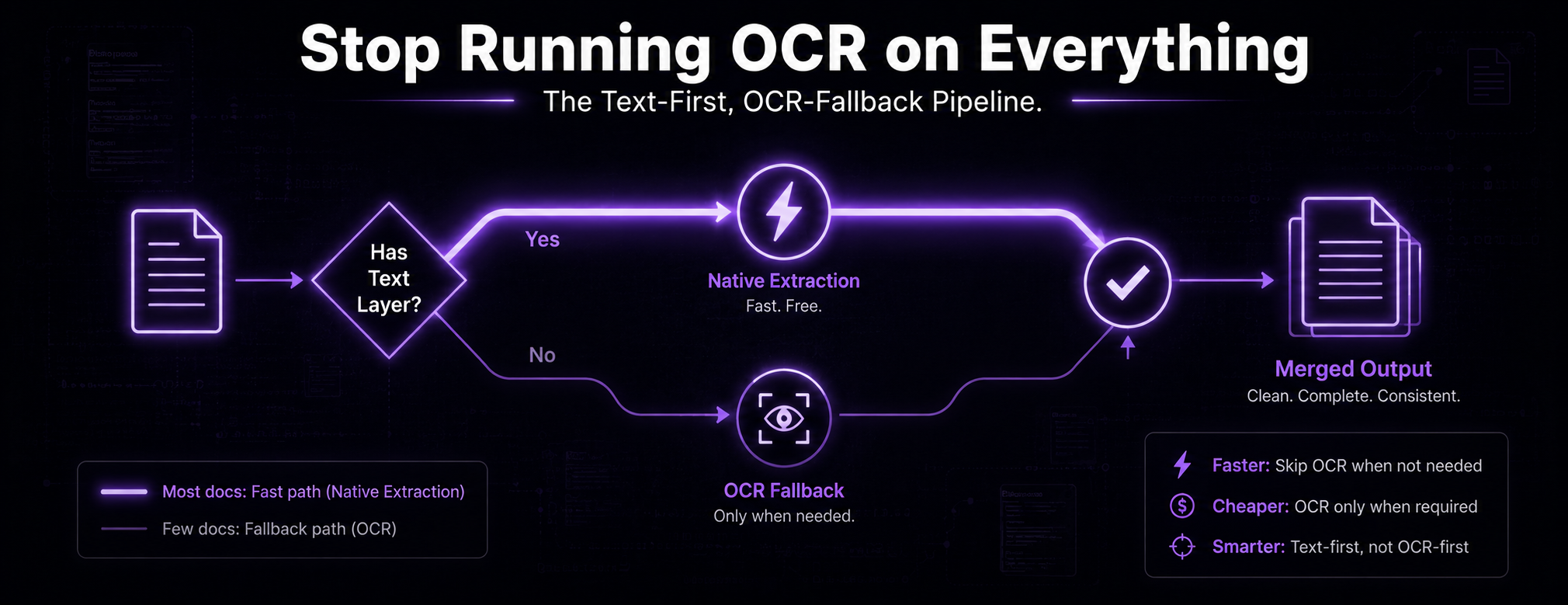
If you are building anything that ingests PDFs, invoices, medical claim forms, contracts, whatever the document type, there is a mistake almost every team makes early on: running every single page through an OCR model by default. It feels like the obvious architecture. PDFs go in, OCR comes out, done.
The problem is that most PDFs are not scanned images. A large share of them are born-digital, meaning they already contain a real, selectable text layer embedded in the file. Running an OCR model on a page like that is the equivalent of hiring a translator to read you a book that is already written in your language. You pay the compute cost, add the latency, and in a meaningful number of cases, get a worse result than if you had simply read the text that was already there.
This is not a minor inefficiency. It is a default architecture decision that most teams never revisit, and it shapes both the cost and the accuracy ceiling of everything built on top of it.
The Better Pattern: Try the Cheap Path First
The alternative is conceptually simple: for every page, attempt to extract the embedded text directly first. Only when that fails, or clearly is not going to work, bring in an OCR model. This is generally called a text-first, OCR-fallback pipeline, or a hybrid extraction pipeline.
Native text extraction, using a library like PyMuPDF, reads a PDF's embedded text layer directly with no model inference involved. It is near-instant, and for a born-digital document, the output is effectively perfect: no hallucinated words, no dropped characters, no GPU required. For most invoices, reports, and digitally generated forms, this single step fully solves the extraction problem without OCR ever entering the picture.
Why the Decision Has to Happen Per Page, Not Per Document
The part that makes this architecture actually useful rather than just theoretically cleaner is that the OCR decision happens at the page level, not the document level. A single PDF can mix born-digital pages with scanned images, and treating the whole document as one or the other wastes the efficiency gain.
Two signals reliably indicate a page needs OCR. Text density: if native extraction returns next to nothing, under roughly 50 characters, that page is very likely a scanned image with no underlying text layer. Image coverage: if a single embedded image occupies most of the page, it is very likely a scan regardless of whether a stray line of text was extracted from somewhere on it.
If either signal fires, that specific page gets routed to OCR. Every other page moves forward with the text already extracted for free. This per-page routing is what actually produces the cost and time savings at scale. You are not deciding whether to run OCR on the document. You are deciding for each page independently, which matters enormously once you are processing documents that mix content types within a single file.
Choosing the OCR Engine Deliberately
For the pages that do need OCR, the choice of engine matters more than most pipeline designs account for. Not all OCR models perform equally well across document types.
Testing this directly on a structured, fixed-layout form (a CMS-1500 medical claim form full of tables, checkboxes, and dense field labels) showed a clear split: one model performed beautifully on clean plain-text pages but degraded badly on the structured form, looping on repeated tokens instead of reading the actual fields. A different engine, PaddleOCR, handled the same structured form noticeably better, correctly extracting field labels and preserving the layout.
The lesson is not that one engine is universally better. It is that the fallback OCR engine should be selected, or even routed dynamically, based on the type of page being processed. A pipeline handling a mix of plain scanned letters and dense structured forms genuinely benefits from more than one OCR engine, chosen by document type rather than applied uniformly.
Closing the Loop: Merging and Logging
Once text has been extracted through both paths, native extraction for the easy pages and OCR for the hard ones, it gets stitched back together in original page order. Whatever consumes the document downstream should not need to know or care which path any given page took.
The step that is easy to skip and should not be is logging which pages took the OCR fallback path. That log serves two purposes: it gives a clear picture of what fraction of a document set is genuinely "hard," which matters for capacity planning, and it provides a fast way to spot-check extraction quality later without re-running the entire pipeline.
Why This Is an Accuracy Argument, Not Just a Cost Argument
The efficiency win here is the obvious one: no GPU time or inference latency spent on pages that did not need it. The less obvious win is accuracy. OCR models, even strong ones, introduce a small amount of noise on every page they process: a misread character, a dropped line, and in some cases on complex structured layouts, a complete structural breakdown of the field content. If a page already has a perfect, ground-truth text layer embedded in the PDF, running it through OCR anyway just gives noise an opportunity to appear where there was none before.
Skipping OCR when it is not needed is not just faster. It produces a more accurate result.
Where This Architecture Extends
The pattern described here is deliberately the simple version: one fallback engine, two straightforward detection signals. At real production scale, the same architectural skeleton extends naturally. Layout-detection models can replace simple threshold checks for the "does this page need OCR" decision. Multiple OCR engines can be routed by document type rather than applied as a single fallback. The core architecture does not change. The detection and routing logic just gets smarter.
The broader point is about default design decisions in AI pipelines generally. "Run the AI model on everything" is almost always the easiest architecture to build first and one of the most expensive to run at scale. The better pattern, in document processing and in most AI-native systems, is to establish the cheap, deterministic path first and let the AI model earn its place as the fallback for what that path genuinely cannot handle.