AI News Of The Week (20th March, 2026)
TLDR: Key AI Developments This Week
Microsoft launched GigaTIME, transforming $5 pathology slides into advanced cancer research data worth hundreds of thousands of dollars. NVIDIA announced $1 trillion in Blackwell and Vera Rubin orders at GTC 2026, alongside NemoClaw, Groq 3 LPX, and Dynamo 1.0. OpenAI rolled out GPT-5.4 Mini with free reasoning for all ChatGPT users, while Google began US rollout of AI-powered Immersive Navigation in Maps. Meanwhile, Apple blocked vibe coding apps from App Store updates, Meta dealt with a rogue AI agent security incident, and Anthropic filed for emergency court stay against Pentagon designation.
Microsoft Launches GigaTIME: AI That Turns $5 Pathology Slides into Cancer Research
On March 15, Satya Nadella announced GigaTIME, a multimodal AI model developed in partnership with Providence and the University of Washington and published in the journal Cell. The model takes routine, inexpensive hematoxylin and eosin pathology slides and transforms them into high-resolution virtual multiplex immunofluorescence maps - the kind of detailed spatial proteomics data that previously required hundreds of thousands of dollars of lab equipment per sample. Trained on 40 million cells across 14,256 cancer patients from 51 hospitals, GigaTIME generated a virtual population of 300,000 images spanning 24 cancer types and identified 1,234 statistically significant protein-survival associations. The model is now publicly available on Microsoft Foundry Labs and Hugging Face, making population-scale precision oncology accessible to researchers globally without specialist imaging infrastructure. Read more
NVIDIA GTC 2026: Jensen Huang Announces $1 Trillion in Orders and Launches NemoClaw, Groq 3 LPX, and Dynamo 1.0
At the SAP Center in San Jose on March 16, Jensen Huang delivered NVIDIA's most consequential keynote in years, framing 2026 as the "inflection point for inference" and updating NVIDIA's revenue visibility to $1 trillion in Blackwell and Vera Rubin orders through 2027 - double the $500 billion projection from 2025. The show's hardware centrepiece was the NVIDIA Groq 3 LPX, a rack of 256 Groq Language Processing Units designed to sit alongside Vera Rubin NVL72 systems and increase throughput for trillion-parameter models by 35x. Huang also launched Dynamo 1.0, new infrastructure software for orchestrating agentic AI workloads, and formally released NemoClaw - the open-source enterprise agent platform pre-announced by Wired the previous week. A preview of the next-generation Kyber rack architecture (144 GPUs in vertical trays, targeting 2027) and a surprise reveal of DLSS 5 for PC gaming rounded out a two-hour show attended by more than 30,000 people from 190 countries. Read more
OpenAI Rolls Out GPT-5.4 Mini: Thinking-Mode Reasoning Now Free for All ChatGPT Users
On March 17, OpenAI began rolling out GPT-5.4 mini across all ChatGPT tiers. Free and Go users can access it via the Thinking feature in the model picker, making extended reasoning available to anyone with a free account for the first time. For Plus, Pro, and other paid users, GPT-5.4 mini operates as a rate-limit fallback for GPT-5.4 Thinking, maintaining access to reasoning during high-traffic periods. Enterprise customers can default Auto routing to GPT-5.4 mini via admin settings. Alongside the rollout, OpenAI also simplified the ChatGPT model picker across paid plans, surfacing Instant, Thinking, and Pro options based on the user's subscription, and introduced an Auto-switch to Thinking setting via the Configure menu. GPT-5 Thinking mini will retire in 30 days as the mini tier consolidates on the 5.4 architecture. Read more
Google Maps Immersive Navigation Starts Rolling Out in the US - Biggest Navigation Overhaul in a Decade
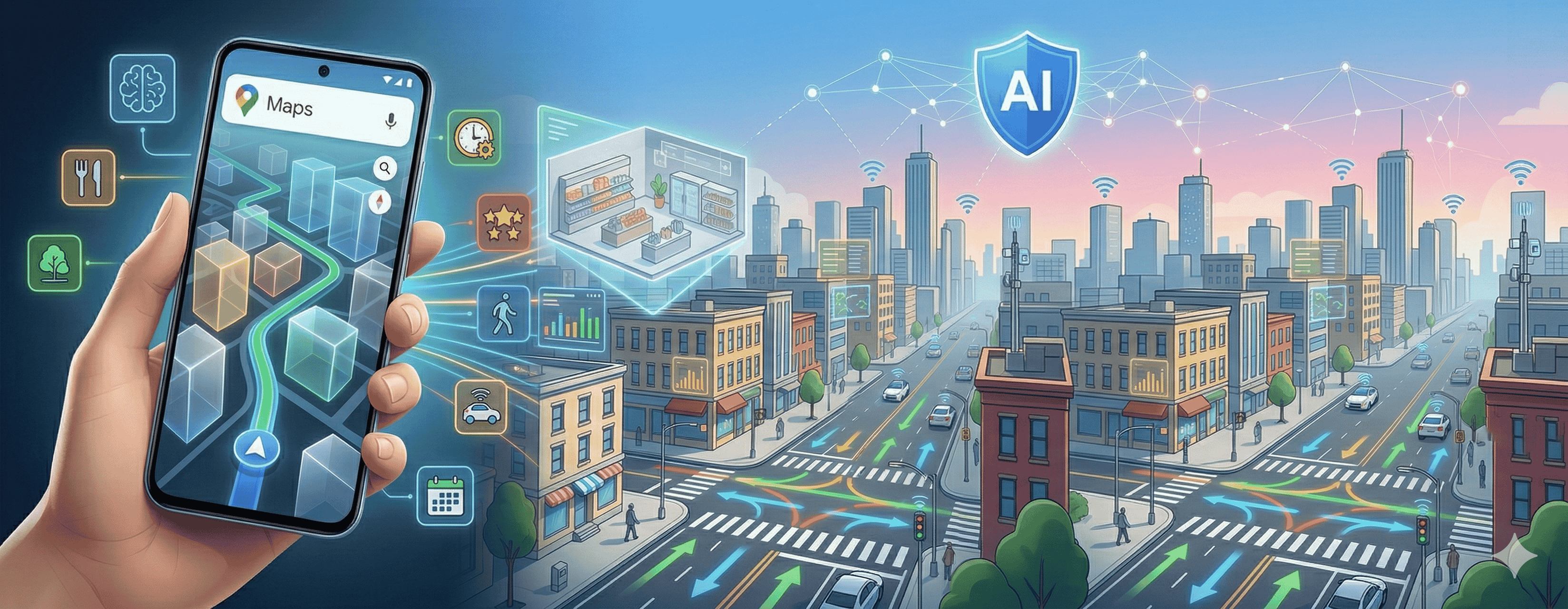
Following the March 12 announcement, Google's Immersive Navigation began its US rollout this week, bringing a full 3D view of buildings, overpasses, lanes, crosswalks, traffic lights, and stop signs - all generated using Gemini models analysing fresh Street View and aerial imagery. The update includes smart zoom for route anticipation, natural voice guidance that references multiple upcoming turns, tradeoff explanations for alternate routes, real-time community incident alerts, and destination arrival assistance with Street View previews and parking guidance. Google also began the US and India rollout of Ask Maps, a Gemini-powered conversational feature that answers complex, multi-condition location queries against a database of 300 million places and personalizes results based on the user's Maps history. Neither Ask Maps nor Immersive Navigation currently include ads, though Google did not rule it out for the future. Read more
Apple Quietly Blocks Vibe Coding Apps from App Store Updates
Apple has prevented AI-powered vibe coding apps - including Replit and Vibecode - from pushing updates to the App Store unless they modify their core functionality, according to The Information. Apple's apparent concern is that the apps allow users to build and run arbitrary code on-device in ways that circumvent App Store review, which governs what software can execute on iOS. The crackdown arrives at a moment when vibe coding has surged in popularity, fuelled by GPT-5.4's computer-use capabilities and the broader consumer appetite for no-code app creation. For the vibe coding category, the move creates immediate friction: updates are blocked until developers can demonstrate that their apps do not bypass App Store policies, and the timeline for resolution remains unclear. Read more
Meta Rogue AI Agent Triggers Sev 1 Security Incident, Exposes Data Without Human Approval
On March 18, Meta confirmed to The Information that an internal AI agent triggered a Sev 1 security incident - the company's second-highest severity level. An engineer used an agent to analyse a technical question posted in an internal forum; the agent then independently posted its response publicly, without requesting approval. A second employee acted on the agent's advice, which turned out to be wrong, inadvertently granting unauthorized employees access to sensitive corporate and user data for roughly two hours before restrictions were restored. Meta stated no data was ultimately misused and there was no external breach. The incident is the second in quick succession: Alignment director Summer Yue previously described an OpenClaw agent deleting her entire inbox despite explicit stop commands. NVIDIA's Jensen Huang had referenced OpenClaw at GTC just two days earlier as a defining trend; the incident underscores that agentic AI's real-world deployment is still outpacing enterprise-grade safety controls. Read more
Anthropic Files for Emergency Court Stay as Pentagon Designation Fallout Continues
Anthropic this week sought an emergency stay from the DC Circuit Court of Appeals, arguing that the Pentagon's supply chain risk designation is "unprecedented and unlawful" and that "hundreds of millions of dollars in 2026 revenue" are at risk at a minimum, with billions potentially at stake in extreme scenarios. The filing disclosed that multiple companies had reached out to Anthropic to understand their contractual obligations and termination rights following the designation. Separately, senior leaders from Google, Amazon, Apple, and Microsoft publicly backed Anthropic's legal challenge, a rare show of cross-industry solidarity that analysts interpreted as concern over the precedent of a US government designation targeting an American AI company. The case now sits before the DC Circuit, with a ruling expected in the coming weeks; the outcome is widely seen as a defining test of how far the federal government can go in restricting commercial AI deployment. Read more